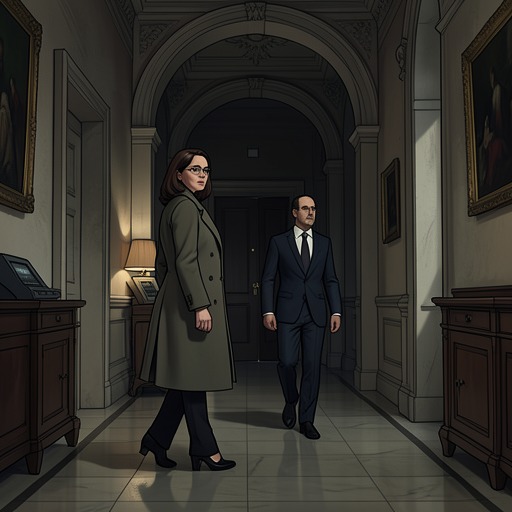
Vanessa’s False 911 Call to Frame Ewan
Slow BurnVanessa MacKenna’s false emergency call is a carefully timed attempt to frame Ewan MacKenna while concealing her own role in a planned explosion. She presents herself as a survivor fleeing a hostage situation, tells the operator that Ewan has Kate MacKenna, and asks for help before the house is due to blow up. The call turns a private plot into an apparent rescue emergency; its intended cover story reaches its crisis when the countdown ends and nothing happens.
Causes and Preparation
The call belongs to a wider threat against Kate. In an earlier investigation, Dylan Buchanan explains that an explosive had been placed inside a flower basket at the gallery, on the ground near the table where Kate had been seated. Kate remembers seeing the flowers after briefly going inside, but not who delivered them. The detail establishes how an ordinary gift could be used to bring danger close to her without attracting attention.
Investigators later find a calendar in Roger MacKenna’s kitchen, beside the phone. Its notes appear in two distinct handwritings, and it records times, places, and Kate’s flight numbers for her trips to and from Boston. The entries link the calendar to the gallery party and a warehouse as well as to Kate’s movements. This wider pattern makes access to her schedule a significant part of the threat, though the cited scenes do not establish who made each note.
At the mansion, Vanessa’s plan depends on presenting an alternative account of events before the explosion. She has moved Ewan’s car to the bottom of the drive and placed her own car behind it. That arrangement gives her a ready explanation for why she could not get nearer to the house: she intends to say Ewan blocked the way. She also anticipates how a caller’s timing will affect the credibility of her story. Rather than wait until after the blast, she decides to call while it is still imminent, so that the operator will hear her pleading for help as the house explodes.
The Staged Escape and Call
Vanessa prepares to look like someone who has escaped in haste. She runs down the hill, deliberately makes herself appear to have fallen, and tears her skirt further when it catches. She checks her watch as she goes. These gestures are not evidence of a genuine flight from danger; they are elements of a performance designed to make the story she is about to tell seem consistent with a panicked escape.
The practical arrangements support the performance. Vanessa has already put the cars where they will be out of the way when the house blows and where their position can substantiate her excuse. She waits until less than three minutes remain, then places the emergency call with roughly two minutes to go. Her story to the operator is that a man has a bomb, intends to kill Kate, and has kept her inside. She identifies Kate by name and identifies Ewan as the brother-in-law who has her.
Vanessa also claims to be safe at the gate, beside her car, after escaping while Ewan looked away. The claim joins her staged appearance to the arranged location of the vehicles: each detail is meant to make the others more persuasive. She keeps the operator on the line and turns the phone toward the house as the final seconds pass. The call is thus not merely a request for assistance. It is a timed accusation, intended to establish a version of the scene before anyone can test it against what has actually happened inside.
What Is Happening Inside
The scene inside the mansion gives the reader grounds to doubt Vanessa’s account. After Vanessa and another person leave the library, Kate cautiously checks the room. Ewan is lying on the floor with his eyes closed, but Kate finds that he is breathing; she wonders whether he, too, has been drugged. She is conscious and trying to get help, not described as being held by Ewan. As she reaches toward the desk for support, she notices a flower basket.
That basket recalls the earlier account of the explosive placed among flowers at the gallery, connecting the immediate danger to the recurring use of floral arrangements. The evidence here does not identify the basket’s contents or confirm what will happen to the house. It does, however, place a significant object within Kate’s reach at the moment she is alone and looking for help. The contrast between what she encounters and what Vanessa tells the operator sharpens the deception: the call names Ewan as captor, while the scene shows him incapacitated and Kate still able to move.
Failed Countdown and Significance
Vanessa’s story is built around the expectation that the explosion will validate it. She tells the operator that Kate remains inside with Ewan, supplies the address at 417 Barkley Road, and stays on the line as the deadline approaches. When the last seconds pass, no explosion occurs. The account therefore ends its immediate action not with the proof Vanessa expects, but with a rupture between her carefully timed performance and the event she has predicted.
The silence does not, by itself, explain why the house does not explode or establish the danger’s final outcome. The following narration gives Dylan Buchanan’s reaction as fear for Kate, not knowledge that she is safe. The scene consequently leaves the central rescue question unresolved at this point. Its decisive reversal is narrower but clear: Vanessa’s call is meant to make her appear to be a witness escaping Ewan, yet the reader has seen her arrange the circumstances and deliver the accusation as part of her own plan.
The episode also turns timing into evidence. Vanessa watches the minutes because her account must coincide with the expected blast; the call’s force depends on a physical event arriving on schedule. Once it does not, the performance loses the confirmation on which it was designed to rely. Alongside the earlier flower-basket bombing and the calendar recording Kate’s travel, the staged call belongs to a pattern in which apparently routine objects, schedules, and explanations can be arranged to conceal a threat. Here the emergency system becomes part of that arrangement: Vanessa uses a request for help to create a misleading account of who is endangered and who is responsible.